

In the 1980s, researchers out of Carleton University in Canada under Dr. Don Andrews began development of a case management model that would become the basis of criminal justice intervention practice in North America and a large part of the western world. The research team conducted targeted research to examine the efficacy of interventions with individuals involved in the justice system. They discovered a pattern. Overall, interventions could seem to have mixed results, yet when separated out by risk level, the picture became more clear. Intervention programs were more effective for individuals with higher risk ratings, yet almost ineffective or even deleterious for individuals rated low risk. Following this discovery, further research was conducted to clarify the bounds to what works in criminal justice intervention. The resulting model is referred to as the Risk Needs Responsivity model (RNR).
Understanding the Three Principles of RNR
The RNR model directs case management practice to maximize effects to reducing risk for justice involved individuals. To help reduce risk, case managers should attend to three principles: 1) the Risk principle aims to target interventions for individuals with moderate to high risk, 2) the Need principle aims to target interventions to the criminogenic need areas most associated with their offending behavior, and 3) the Responsivity principle aims to maximize benefit by ensuring interventions are suited to an individual’s learning style and needs. Decades of research have supported improvement in outcomes for individuals supervised with adherence to this model.
Orbis Partners: Translating Research into Tools
Dr. Dave Robinson was a part of the original research team under Dr. Don Andrews developing the RNR model. Dr. Robinson brought his expertise with risk assessment into the founding of Orbis Partners in 2002. Together with industry experts, they developed comprehensive assessment for case management and success planning with two tools: the Youth Assessment and Screening Instrument (YASI) for youth and the Service Planning Instrument (SPIn) for adults. These tools were designed to aid supervising officers and case managers in bolstering success by guiding interventions to adhere to the RNR approach.
What sets the YASI and SPIn apart from other assessment tools in the field is the breadth of information provided by the full assessment includes needs and strengths assessed along each domain, and the “Wheel” that helps to use the assessment to plan intervention strategy for that person.
RNR in Practice
Once an assessment has been completed, the YASI and SPIn tools produce a visual “Wheel” to display the individual’s risk, needs, and strengths along each domain. The Wheel is designed to orient case managers to target intervention strategy with the RNR approach. Risk: Dynamic risk level is assessed for each domain. Needs: Interventions can be tied to the need areas with the requisite risk level. Case managers are trained to select which domains are most relevant for the individual’s behavior and to bolster support. Areas that also have low strengths may warrant priority for intervention. Responsivity: The specific intervention approach can be tailored to the individual’s learning style. For some individuals, that may mean individual versus group work, for example. See the Wheel for a sample SPIn assessment below:
SPIn | Sample Assessment Result
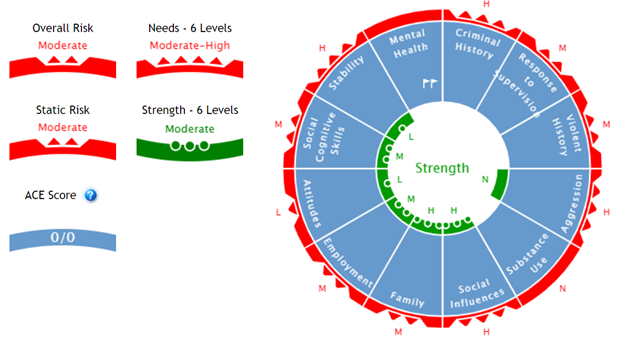
The Wheel displays the individual’s ratings on all assessed domains. Ratings that indicate increased risk and needs are in red on the outside of the wheel. Ratings that reflect mitigating risk or strengths are on the inside of the wheel in green. Ratings reflect N = none, L = Low, M = Moderate, and H = High. Note mental health includes flags but is not rated for risk.
In this case example, we want to tailor our intervention strategy to target the areas of greatest need and bolster strengths in those areas. Looking first at the overall picture, we have an adult with overall moderate risk who has been rated moderate to high in historic (static) criminal history factors: criminal history, response to supervision, and violent history. The violence history is something to target for case planning.
Turning our attention to the dynamic domains, we see high dynamic needs on stability, social influences, and aggression. The strength information indicates this individual also rated high strengths in social influences, whereas stability and aggression have low or no strengths. Therefore starting with prioritizing stability and aggression may be the place to start for this person. Targeting aggression will hopefully provide the individual with the skills to curb future violent behavior. Another thing to note about this case example is the two flags for mental health needs. This individual may benefit from support that bolsters both stability and mental health to improve their opportunity for success.
As this example shows, the SPIn assessment is well suited to bolster RNR approach to case management. Assessments are best when given every three months so the case manager can monitor progress and move on to other domains for support.
Research in Practice
The SPIn and YASI assessment tools are also well suited to provide data for evaluation on the larger scale. Data can inform validation for the population, tracking progress over time, program evaluation, and fidelity to process. Reassessment with the SPIn and YASI assessment tools provides data to track progress over time. Assessments are recommended to be given every 3 months. Reassessment data can inform overall rates of improvement in specific domain areas within an agency. Specifically, reassessment data can inform whether interventions provided seem to be working to reduce needs for clients with pre/post comparisons of scores. Agencies can use this information to evaluate the efficacy of their programming and models. Assessment data can also inform fidelity to process and the RNR model. Researchers can examine whether case managers prioritized Risk and Need principles in service planning.
Research conducted in 2024 in Canada sought to use SPIn assessment data to evaluate the efficacy of an adult reentry program. SPIn assessments were compared pre and post intervention and informed improved outcomes in the form of reduced needs and bolstered strengths in the targeted need areas. This data was provided to Public Safety Canada to inform program efficacy for future funding.
Recent research in the southern U.S. is currently underway in collaboration with a justice agency and a private research agency. The research team used YASI assessment data to inform whether case management conformed with RNR matching and whether programming resulted in improved outcomes. Results from this research will inform fidelity to process as well as program efficacy within this jurisdiction.
Evidence-Based Tools for Lasting Impact
The assessment tools developed by Orbis Partners were developed with evidence based practice to provide robust information to decision makers and case managers to help bolster success for justice involved individuals. The information provided by these assessments is tailored to bolster the work of case managers for each individual, but can also be used to inform larger scale research questions. Orbis provides continued investment in research partnerships and innovation to ensure the best possible outcomes for individuals and to ensure the best possible tools for decision makers and case managers.
Orbis Partners provides solutions for criminal justice and human services systems, specializing in designing and implementing services for at-risk client groups. Orbis' risk, needs and strengths assessment tools are designed to guide the casework process by incorporating an individual's unique set of needs. For more information about our assessments, visit our Assessments page.